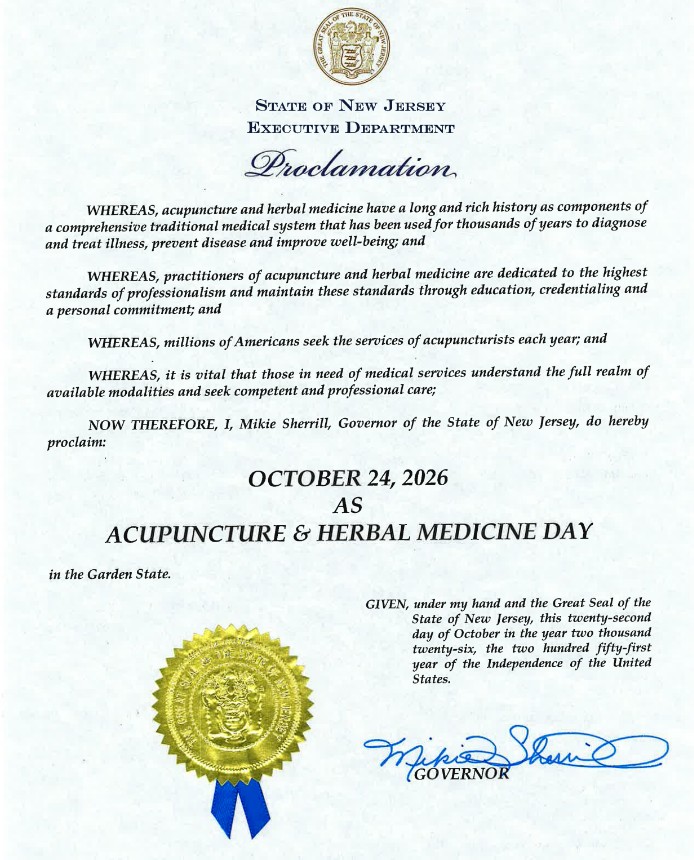
New Jersey officially recognized October 24, 2026, as Acupuncture & Herbal Medicine Day, acknowledging the long history of these traditional medical practices, their contributions to health and wellness, and the importance of professional standards in patient care.
Following outreach by the New Jersey Acupuncture Society to Governor Mikie Sherrill’s office, the Governor issued a formal proclamation recognizing acupuncture and herbal medicine and encouraging greater public awareness of the treatment options available to New Jersey residents.
The proclamation highlights the thousands of years of history behind acupuncture and herbal medicine, the commitment of practitioners to professional education and credentialing, and the millions of Americans who seek acupuncture treatment each year.
For Dr. Robert Lenahan, a longtime acupuncture practitioner in Point Pleasant, New Jersey, the recognition is particularly meaningful. As New Jersey’s first licensed acupuncturist and a former chairman of the state’s Acupuncture Examining Board for more than two decades, Dr. Lenahan helped establish the professional licensing framework that continues to protect acupuncture patients throughout the state.
Why New Jersey Recognized Acupuncture & Herbal Medicine Day
Acupuncture & Herbal Medicine Day is observed nationally each October 24. First commemorated in 2002, the annual observance was established to increase public awareness of acupuncture, its potential health benefits, and its role in modern healthcare.
New Jersey’s 2026 proclamation supports these goals by emphasizing the importance of educating the public about available healthcare approaches and encouraging patients to seek competent, professional treatment.
The proclamation specifically recognizes the dedication of acupuncture and herbal medicine practitioners to maintaining high standards through education, credentialing, and personal commitment.
This recognition is especially relevant as more Americans explore complementary healthcare options. According to the National Institutes of Health (NIH), the percentage of American adults reporting acupuncture use more than doubled between 2002 and 2022.
Acupuncture’s Growing Role in Modern Healthcare
Acupuncture is a traditional Chinese medical practice that involves inserting very fine needles into carefully selected points on the body. The practice has been used for thousands of years and is increasingly incorporated into contemporary approaches to pain management and integrative healthcare.
In traditional Chinese medicine, acupuncture is used to influence the body’s Qi, a concept associated with the functions and balance of the body’s systems. Modern research suggests that acupuncture may affect the nervous system and other tissues, although its mechanisms are not yet fully understood.
One of the most common reasons patients seek acupuncture is relief from persistent pain. Research reviewed by the NIH indicates that acupuncture may help people experiencing chronic lower back pain, neck pain, osteoarthritis-related knee pain, and certain types of headaches.
Acupuncture has also been studied for seasonal allergy symptoms, nausea associated with cancer treatment, and other health concerns. The strength of the scientific evidence varies depending on the condition.
For many patients, acupuncture offers a non-drug treatment option that can be incorporated into an existing healthcare plan. It may be used alongside conventional medical treatment, with appropriate communication between practitioners and physicians.
What Can Patients Experience From Acupuncture Treatment?
People who have never experienced acupuncture sometimes hesitate because they associate the treatment with injections or blood draws. However, acupuncture needles are considerably thinner than conventional hypodermic needles, and many patients experience little discomfort during insertion.
At the Acupuncture Practice of Robert Lenahan in Point Pleasant, treatment begins with a detailed evaluation of the patient’s health history, current concerns, medications, and treatment goals.
Dr. Lenahan uses traditional Chinese diagnostic techniques, including pulse and tongue examination, to develop an individualized treatment plan. He emphasizes selecting the fewest appropriate acupuncture points rather than using an unnecessarily large number of needles.
Depending on the condition being addressed, patients may experience reduced pain, improved comfort, or relief from certain symptoms. Many also find their acupuncture appointments relaxing, and some fall asleep during treatment.
The number of visits recommended depends on several factors, including the severity and duration of the condition, the patient’s overall health, and their response to treatment. Acute problems may require fewer appointments, while chronic conditions often benefit from a longer course of care.
Acupuncture is generally considered safe when performed correctly by a qualified practitioner using sterile, single-use needles, although temporary soreness, bruising, or lightheadedness can occur. Results vary, and acupuncture should not replace necessary medical evaluation or treatment.
New Jersey’s Commitment to Professional Acupuncture Standards
The Governor’s proclamation also recognizes the importance of professional training and credentialing.
New Jersey regulates acupuncture through the Acupuncture Examining Board, which operates under the supervision of the State Board of Medical Examiners. The Board establishes licensing requirements, oversees professional standards, and works to protect patients receiving acupuncture services.
Dr. Robert Lenahan played an important role in the development of acupuncture as a licensed healthcare profession in New Jersey. After graduating from Boston College with a degree in biology, he attended the New England School of Acupuncture as a member of its first graduating class. He continued his clinical education at the International College of Oriental Medicine in England and trained with an experienced Chinese physician in New York City.
He later participated in the effort to establish acupuncture licensing in New Jersey and served as chairman of the Acupuncture Examining Board for more than 22 years.
His experience in both clinical practice and professional regulation reflects the same commitment to education, competency, and patient care emphasized in the Governor’s proclamation.
Learn More About Acupuncture in Point Pleasant, NJ
New Jersey’s recognition of Acupuncture & Herbal Medicine Day provides an opportunity for residents to learn more about this longstanding medical tradition and consider how acupuncture might fit into their personal healthcare plans.
At the Acupuncture Practice of Robert Lenahan, patients receive individualized attention from a practitioner with decades of experience in traditional Chinese medicine. Dr. Lenahan works with patients experiencing chronic pain, musculoskeletal concerns, seasonal allergies, and other health conditions, helping them understand their treatment options and establish realistic goals.